Saturday, July 04, 2015

Transformation of String into Date respecting Locale

Let's say you need to parse a string into date and it is localized string (f.x. name of month on local language). In past I would definitely define an array with months and then parse a String to get a number of my month and then build a Date object. In Java it's pretty simple (almost 1 line of code).

Locale approach

package parser;

import java.text.ParseException;
import java.text.SimpleDateFormat;
import java.util.Date;
import java.util.Locale;

public class parser {

 public static void main(String[] args) throws ParseException {
  Locale locale = new Locale("ru");
  Date date = convertStringToDate("19 Сентября 2004", "d MMMM yyyy", locale);
  System.out.println(date); // Sun Sep 19 00:00:00 CEST 2004
 }
 
 public static java.util.Date convertStringToDate(String dateString, String format, Locale locale) throws ParseException {
  return new SimpleDateFormat("d MMMM yyyy", locale).parse(dateString);
 }
}
Alternatively, if you need to define months yourself use DateFormatSymbols

Define symbols in DateFormatSymbols

package parser;

import java.text.DateFormatSymbols;
import java.text.ParseException;
import java.text.SimpleDateFormat;

public class parser {

 public static void main(String[] args) throws ParseException {
  String months[] = {"Январь", "Февраль", "Март", "Апрель", "Май", "Июнь", "Июль", "Август", "Сентябрь", "Октябрь", "Ноябрь", "Декабрь"};
  DateFormatSymbols dfs = new DateFormatSymbols();
  dfs.setMonths(months);
  
  SimpleDateFormat sdf = new SimpleDateFormat("d MMMM yyyy");
  sdf.setDateFormatSymbols(dfs);
  System.out.print(sdf.parse("19 Сентября 2004")); // Sun Sep 19 00:00:00 CEST 2004
 }
}

Monday, June 15, 2015

Insufficient memory - NSF pool is full

Recently I've faced up with an odd issue. When users tried to open Lotus Notes applications they got a warning saying
Insufficient memory - NSF pool is full

What 'Insufficient memory - NSF pool is full' is about?

As far as I understood it is memory leak on IBM Domino server. There are different kind of issues similar to this one:
  • Insufficient memory - NSF pool is full
  • Insufficient memory - index pool is full
  • Insufficient memory - NSF directory manager pool is full
  • Insufficient memory - Event pool is full
  • Insufficient memory - NSF Monitor pool is full
  • Insufficient memory - Network pool is full

Fixing the issue

Of course it require investigation why it happened but as a temporary fix you can simple increase memory while you are looking into the problem (if you do so :)). The variable name responsible for this pool is NSF_Buffer_Pool_Size (number of bytes) or alternatively you can use NSF_Buffer_Pool_Size_MB (number of megabytes). I'm not going to explain details about this variable, since you can find everything on IBM, just open this link: NSF_Buffer_Pool_Size

Adding or changing NSF_Buffer_Pool_Size_MB in notes.ini

I didn't find a default size for NSF_Buffer_Pool_Size (One article mentioned 32MB as a default value, however I could not really confirm that with IBM documentations). Anyway, for I set 64MB and from now I will keep my eyes open on this problem.
Let's change notes.ini using a Configuration Settings document
  1. First, open IBM Domino Administrator and find a Configuration tab there.
  2. Find Configuration settings now (in R9, it's nuder Server\Configurations), if it is not there, you may need to create it first.
  3. Highlight right server and and click button Edit Configuration and switch to NOTES.INI Settings tab.
  4. There must be a button: Set/Modify Parameters at the bottom, click on it and add/change your variable.
  5. Save configuration and Restart Server.

Done.

Tuesday, May 05, 2015

ColumnValuesIndex property of NotesViewColumn

Since there is no documentation about property ColumnValuesIndex of class NotesViewColumn. Let me describe it.
Let's create a view with 7 columns:
  1. @DocNumber
  2. Hidden (sorting) column that does sorting
  3. Column with formula value: Form
  4. Icon (static value: 12)
  5. Column with formula value: @Created
  6. Constant value: 100
  7. Total with 'hide details row' enabled (for each row value: 1)

Analyze ColumnValuesIndex

Let's write some code and check what exactly ColumnValuesIndex returns
  Dim ws As New NotesUIWorkspace
  Dim view As NotesView
  Dim col As NotesViewColumn
  Dim i As Integer
 
  Set view = ws.CurrentView.View
  For i = 0 To view.ColumnCount - 1
    Set col = view.Columns(i)
    Msgbox col.ColumnValuesIndex
  Next
The result for columns will be: -1, 0, 1, -1, 2, -1, 3.
We may see now that for some of columns we got (-1). Let's look on these 3 columns and try to guess how they are different compare to other columns. Here is my assumptions for what cases it returns (-1)
  • A formula containing a UI-only function such as @IsExpandable or @DocNumber.
  • A constant.

Summary for ColumnValuesIndex

Otherwise it returns columns position (without taking into account columns with -1), It looks like it is exactly same logic as in notesViewEntry.ColumnValues

Monday, May 04, 2015

Refresh embedded view

Here is the classic old issue. I've a form with embedded view on it (Show single category is used as well). There is an action on a view that create a new documents (which should be displayed in that embedded view). These solutions most likely wont work
  • ws.ViewRefresh will not help
  • Refreshing NotesUIDocument may cause a Notes client to crash, so it is not a way to go as well.
Here are some possible ways to solve it:

Refresh view by simulating of pressing F9

While searching for an example I found it on my blog :-), so you can easily find it here: how to emulate F9 key and save some minutes.

Refresh view by changing focus to another fields

The idea is to have 2 fields (let's call them FieldA and fieldB). Once you need to refresh embedded view - set focus to fieldA and then change it to fieldB. You also need either add refresh logic on Exiting property of fieldA (I prefer it, as it will not cause the perfomance on a form) or enable Automatically Refresh fields.

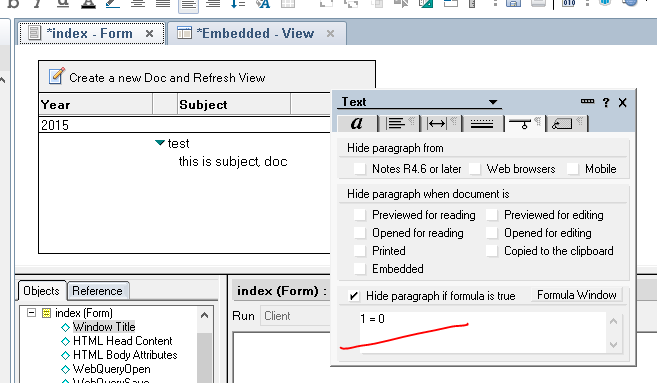
Refresh embedded view using hidden formula

Here the idea is to make sure we have hidden formula on Embedded View (even such like 1 = 0) and use Refresh
And here is code examples
  Call ws.ViewRefresh
  Call uidoc.RefreshHideFormulas
  Call ws.ViewRefresh

Please have a look on these 2 articles that inspired me:
  1. Refreshing an embedded view
  2. How to refresh NotesUIDocument from categorized embedded view

Monday, January 05, 2015

Find Orphan pages on website

You have a website and want to be sure that there are no Orphan pages? Not sure how to develop it? If so - you found a right place to go :), let's talk about most important steps.
I assume you have a list of all pages you want to verify (otherwise - it will be your first task)

Here is a logic/snippets
  1. We need functionality that can extract HTML from a web page. Later we will scan it and get internal links.
    private String getPageContent(String pageurl) throws Exception {
       StringBuffer buf = new StringBuffer();
       URL url = new URL(pageurl);
       InputStream is = url.openConnection().getInputStream();
       BufferedReader reader = new BufferedReader( new InputStreamReader( is )  );
       String line = null;
       while( ( line = reader.readLine() ) != null )  {
          buf.append(line);
       }
       reader.close();  
       return buf.toString();
    }
  2. Make a logic that can deal with DOM. I use jsoup to manipulate with HTML and I really recommend it (easy and fast). The method below select all links that begin with baseurl (it's domain of your website), in that way we can cut all external links and get only internal links.
    private List<string> getAllInernalLinks(String html, String baseurl) throws Exception {
       List<string> res = new ArrayList<string>();
       String select = "a[href^="+baseurl+"]";
       org.jsoup.nodes.Document dom = Jsoup.parse(html);
       Elements links = dom.select(select);
    
       for (Element link : links) {
          String src = link.attr("href");
          res.add(src);
       }
       return res;
    }
  3. Now we must build a List with all internal links from all pages on your website.
    String List<string> alllinks = getAllInernalLinks(html_from_all_pages, baseurl);
  4. We need to make sure that pageurl can be found in alllinks more then in pagelinks (to avoid case when page has link to itself).
    private boolean isOrphan(List<string> pagelinks, List<string> alllinks, String url) throws Exception {
       if (Collections.frequency(alllinks, url) > Collections.frequency(pagelinks, url)) {
          return false;
       }
       return true;
    }

Wednesday, October 29, 2014

Formatting a URL link in Drupal using function l

Another nice function in Drupal. It's called function l.
It formats a URL link as an HTML anchor tag.
I know it looks really easy and simple, it's just nice to use it after doing that manually many times.
$option = array();
$option['attributes'] = array('title' => $label);
l($label_trimmed, $uri['path'], $option));// will output [a href="$uri-path" title="$label">[/a]

Tuesday, October 28, 2014

Truncating a string on a word boundary in Drupal

Typical task: "truncate a string only on a word boundary and add a some postfix to resulting string". Every developer did it many times, I'm sure. Here is a how Drupal solves it with it's api: function views_trim_text
define(MAX_LENGTH, 30);

$alter = array(
    'max_length' => MAX_LENGTH,
    'word_boundary' => TRUE,
    'ellipsis' => TRUE
);

$mystring = "truncate a string only on a word boundary and add a some postfix to resulting string";
$mystring = views_trim_text($alter, $mystring); //result is 'truncate a string only on a...'

Monday, September 08, 2014

Issues when importing WSDL files into Web Service Consumer

Recently I faced up with WSDL which I couldn't import into Web Service Consumer. Our consumer worked well from last 5 years but it is a long period and during that time our Service Provider was updated a lot so we decided to update our Consumer as well. Guess everything went fine?
No WSDL was returned from the URL
I simply created new Consumer in Domino Designer, set URL to our WSDL, picked Java and clicked OK. Oops...
---------------------------
Domino Designer
---------------------------
No WSDL was returned from the URL:
https://api.ourserver.com/secure/api1/WebService?WSDL
---------------------------
OK
---------------------------
The requested operation failed: no import files
Wow, thought I :) let's try to import WSDL as Lotus Script then (just to see if it is not related to Java)
---------------------------
IBM Domino Designer
---------------------------
The requested operation failed: no import files
---------------------------
OK   
---------------------------
Name too long
Hey, what? This WSDL is used by many another applications without any issues, what is going on!? I downloaded WSDL as file to my local PC and tried to import it as Lotus Script again. This time it went fine (except issues with Name too long). Well, great news anyway, at least everything works when WSDL is a local file.


The Web Service implementation code generated from the provided WSDL could not be compiled, so no design element was created
Ok, it worked for Lotus Script, let's set now Java...
---------------------------
IBM Domino Designer
---------------------------
The Web Service implementation code generated from the provided WSDL could not be compiled, so no design element was created.  Please correct the WSDL and try again.  The errors are located in the following file:: C:\Users\dpa\AppData\Local\Temp\notes90C43B\47238811.err
---------------------------
OK   
---------------------------
OK, it's time to blame Designer and IBM! Why it is so difficult just to import WSDL? All another application that use WSDL from our server did not have such issues. It's just not fair :). Found a file with error and quite typical line: java.lang.OutOfMemoryError: Java heap space. I knew what to do, I increased HTTPJVMMaxHeapSize and JavaMaxHeapSize to 512M, restarted Designer/Notes and tried again. Worked well! I restored original values to HTTPJVMMaxHeapSize and JavaMaxHeapSize after that.
The system is out of resources.
Consult the following stack trace for details.
java.lang.OutOfMemoryError: Java heap space
at com.sun.tools.javac.util.Position$LineMapImpl.build(Position.java:151)
at com.sun.tools.javac.util.Position.makeLineMap(Position.java:75)
at com.sun.tools.javac.parser.Scanner.getLineMap(Scanner.java:1117)
at com.sun.tools.javac.main.JavaCompiler.parse(JavaCompiler.java:524)
at com.sun.tools.javac.main.JavaCompiler.parse(JavaCompiler.java:562)
at com.sun.tools.javac.main.JavaCompiler.parseFiles(JavaCompiler.java:816)
at com.sun.tools.javac.main.JavaCompiler.compile(JavaCompiler.java:739)
at com.sun.tools.javac.main.Main.compile(Main.java:365)
at com.sun.tools.javac.main.Main.compile(Main.java:291)
at com.sun.tools.javac.main.Main.compile(Main.java:282)
at com.sun.tools.javac.Main.compile(Main.java:99)
at lotus.notes.internal.IDEHelper.compile(Unknown Source)
Simple thing however it costed few hours for me. Hope it will save some time for other people.

Tuesday, July 08, 2014

Track events using google analytics via hitCallback

If you are using google analytics to track clicks/events then at some point you may want to track submits of forms. The only one way to do that is to use hitCallback function. It is easy to do it, however many people forget to verify cases when google analytics library is blocked, f.x. by extensions AdBlock or Ghostery) and it means hitCallback will not be defined and simply will not work.

Google analytics classic
jQuery(".form").on("submit", function(f) {
  var _this = this;
  _gaq.push(['_set','hitCallback',function() {
    $(_this).parents('form').first().submit();
  }]);
  _gaq.push(['_trackEvent', '/signup']);
  // here is check if google-analytics.js is loaded and if not - return true, otherwise false
  return !window._gat;
})
Google analytics universal
jQuery(".form").on("submit", function(f) {
  var _this = this;
  ga('send', 'pageview', '/signup', {
    'hitCallback': function() {
      $(_this).parents('form').first().submit();
    }
  })
  // here is check if google-analytics.js is loaded and if not - return true, otherwise false
  return !(ga.hasOwnProperty('loaded') && ga.loaded === true);
})